Enable secure application access anywhere to support hybrid work, rapid onboarding, and organizational change.
Improving Posture
Reduce risk by consistently enforcing a single, adaptive risk-based access policy across any user type or location.
Operational Simplicity
Deliver secure access across any user type with a single platform that reduces complexity and operational burden.
Cato Universal Zero Trust Network Access delivers application access that adapts to risk and protects the network.
It enforces least privilege access, allowing users to connect securely from any device or location with full visibility and centralized policy control.
Single Policy Across All User Types,
Devices and Locations
Apply one consistent Zero Trust policy across every user type—employees, contractors, partners—on any device, from any location. Eliminate policy gaps while reducing operational burden and delivering consistent enforcement everywhere.
Cato UZTNA continuously adapts access based on risk, device posture, user behavior, and application risk. Unlike legacy VPNs, this Zero Trust policy enforcement protects sensitive data while keeping the user experience friction-free.
Connect securely to private applications from any device or location without exposing the network. Enforce least-privilege access with complete visibility and single policy control.
Secure BYOD and Contractor
Access Without a Client
Secure employee and third-party application access against phishing, malware, and data loss. Apply Enterprise Browser or Browser Extension controls to protect sensitive data and meet compliance without compromising user experience.
Solving For Today’s Enterprise Network Access Demands
Cato delivers on zero trust network access needs with the simplicity of a single dashboard, the shared context of a unified data lake, and the agility of a fully cloud-native architecture.
Enable secure application access from anywhere to support hybrid and remote work.
Accelerate onboarding for employees, contractors, and partners without complex integrations.
Arm business change by extending access quickly during enterprise scaling and M&A.
Deliver consistent access experiences across offices, homes, and third-party environments.
Enforce least-privilege access to applications based on identity, device, and risk.
Eliminate policy gaps by applying a single access policy across the business.
Prevent lateral movement by removing network-level access to private applications.
Reduce breach exposure with continuous inspection and threat prevention for all access.
Simplify secure access and minimize vendor sprawl by replacing legacy VPNs and point solutions with one platform.
Reduce operational overhead with single policy management and unified access controls.
Ease audit and compliance efforts through consistent, centrally enforced access policies.
See Universal ZTNA
in Action
Secure BYOD Access in Under 2 Minutes with the Cato Browser Extension
Cato Browser Extension: Secure Access for Any User
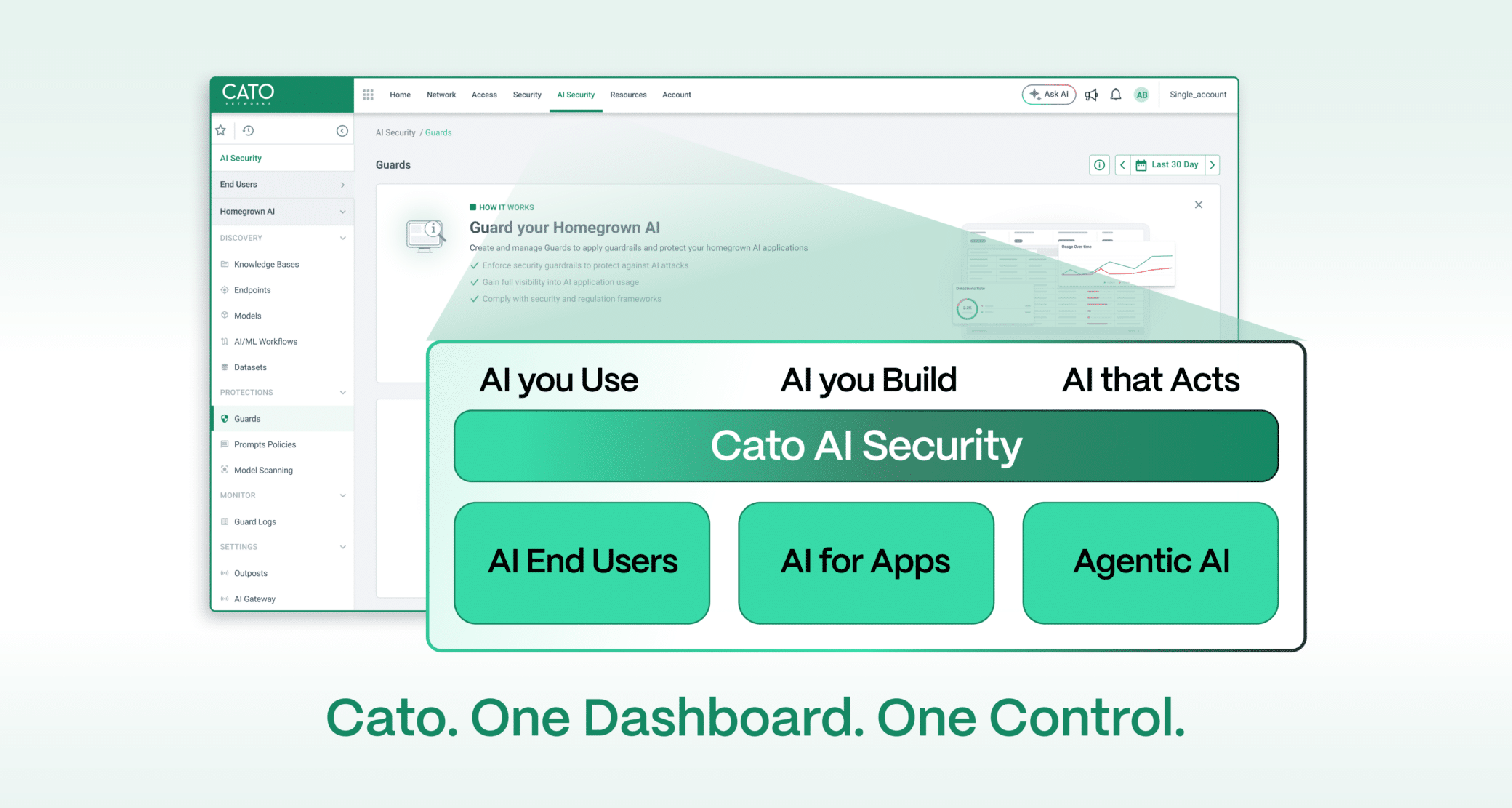
Securely embrace the transformative power of AI across the business. Cato AI Security secures and governs all AI interactions, from safe and sanctioned third-party AI usage to runtime protection of homegrown AI applications and AI agents.
Ensure resilient, high-performance networking with zero-trust protection and AI-driven optimization. Cato next gen-networking connects every user, site, and application through a single, cloud-native platform that delivers optimized global connectivity and seamlessly coexists with existing security and access infrastructure.
Deliver comprehensive Zero Trust protection that unifies threat prevention, application and data security, UZTNA, and AI-driven incident detection and response. Cato SSE provides context-aware protection and seamless scalability across users, locations, clouds, and applications, and can be deployed independently of existing networking infrastructure.
Experience streamlined operations, stronger threat prevention and detection, granular application and data security, and optimized user experience everywhere. Cato’s SASE platform converges networking, security, and access into a single, global, AI-powered cloud service that transforms enterprise infrastructure and empowers IT to securely and optimally connect users, sites, applications, and clouds anywhere business happens.
Prevent advanced attacks and minimize business risk through continuous, real-time security enforcement.
Application and Data Control
Prevent data exposure with consistent control across cloud, web, and private applications.
Operational
Simplicity
Centralize visibility and enforcement, with a single policy.
Cato replaces fragmented security tools with a unified, cloud-native Zero Trust platform that eliminates implicit trust, protects data everywhere, and simplifies operations through consistent policy enforcement and full visibility across all users, applications, and locations.
Converged Threat
Prevention
Prevent threats by inspecting all enterprise traffic in a single pass using converged SWG, IPS, NGAM, DNS Security, RBI, and Sandbox to block phishing, malware, exploits, and zero-day attacks without adding appliances or degrading performance.
Keep Applications
and Data Secure
Prevent data loss by controlling access to SaaS, cloud, and private applications while inspecting content in real time with integrated CASB and DLP to enforce policy and protect sensitive information everywhere.
Zero Trust Access
for Enterprises
Simplify operations, accelerate hybrid-work agility, and reduce risk with a single cloud-native platform that delivers secure application access anywhere, enforces adaptive least-privilege policy universally, and replaces legacy VPNs and point solutions.
Accelerate incident response by correlating network, security, and endpoint signals from a unified data lake, using AI-driven XDR and optional MDR delivered through a single platform or managed service.
Deliver consistent, cloud-native security across all users and locations, eliminating appliance sprawl. With integrated microsegmentation, limit lateral movement, reduce breach impact, simplify operations, and strengthen Zero Trust enforcement without increasing IT workload.
Cato delivers unified, cloud-native Zero Trust security that eliminates implicit trust, protects applications and data everywhere, and simplifies operations through consistent, single-pass policy enforcement across all users, devices, locations, and clouds.
Eliminate implicit trust across users, devices, applications, and locations
Segment networks to prevent lateral movement and unauthorized access
Restrict access to applications, not networks, by identity and risk
Secure web and private access without exposing infrastructure
Inspect traffic inline to prevent sensitive data exfiltration
Control SaaS and cloud application usage, including shadow IT
Enforce data protection policies consistently across all access paths
Secure encrypted traffic without breaking applications or user experience
Consolidate security controls into one cloud-native platform
Apply one policy model across network, security, and access
Eliminate appliance management, upgrades, and capacity planning
Accelerate incident investigation with correlated, AI-driven insights
Securely embrace the transformative power of AI across the business. Cato AI Security secures and governs all AI interactions, from safe and sanctioned third-party AI usage to runtime protection of homegrown AI applications and AI agents.
Ensure resilient, high-performance networking with zero-trust protection and AI-driven optimization. Cato next gen-networking connects every user, site, and application through a single, cloud-native platform that delivers optimized global connectivity and seamlessly coexists with existing security and access infrastructure.
Enable adaptive, risk-based, zero-trust access to private applications located on-premises or in the cloud. Cato offers a wide variety of access methods including ZTNA Client, Enterprise Browser, Browser Extension, and Clientless Portal that can coexist with current access solutions and be selectively deployed to secure some or all application access.
Experience streamlined operations, stronger threat prevention and detection, granular application and data security, and optimized user experience everywhere. Cato’s SASE platform converges networking, security, and access into a single, global, AI-powered cloud service that transforms enterprise infrastructure and empowers IT to securely and optimally connect users, sites, applications, and clouds anywhere business happens.
Govern AI usage across users, applications, and agents. Eliminate shadow AI and maintain compliance.
Operational Efficiency
Simplify AI security operations. Eliminate fragmented AI security tools and manual oversight.
Trustworthy AI Guardrails
Ensure safe and reliable AI behavior. Prevent data leaks, runtime attacks, and compliance gaps.
Cato AI Security secures the AI adoption journey through a cloud-native solution that delivers holistic protection and governance. It provides a unified solution to manage AI usage, applications, and agents at enterprise scale.
Secure AI Usage for
End Users
Secure the AI tools and agents employees use every day. Cato AI Security discovers shadow AI and coding agents, governs AI interactions across prompts and responses, and prevents data leakage to enable safe, compliant AI adoption without blocking productivity.
Protect homegrown AI applications, agentic workflows, and managed agents in production. Cato AI Security prevents AI-specific attacks like prompt injection and jailbreaks, traces agent behavior, and enforces policy before agents execute to ensure AI behaves as intended when operating autonomously.
Protect local, managed, and custom agents across AI use and AI build. Cato AI Security monitors agent behavior, prevents prompt injection and data leakage, and enforces runtime controls, ensuring agents operate as intended across tools, APIs, and connected systems.
Ensure resilient, high-performance networking with zero-trust protection and AI-driven optimization. Cato next gen-networking connects every user, site, and application through a single, cloud-native platform that delivers optimized global connectivity and seamlessly coexists with existing security and access infrastructure.
Deliver comprehensive Zero Trust protection that unifies threat prevention, application and data security, UZTNA, and AI-driven incident detection and response. Cato SSE provides context-aware protection and seamless scalability across users, locations, clouds, and applications, and can be deployed independently of existing networking infrastructure.
Enable adaptive, risk-based, zero-trust access to private applications located on-premises or in the cloud. Cato offers a wide variety of access methods including ZTNA Client, Enterprise Browser, Browser Extension, and Clientless Portal that can coexist with current access solutions and be selectively deployed to secure some or all application access.
Experience streamlined operations, stronger threat prevention and detection, granular application and data security, and optimized user experience everywhere. Cato’s SASE platform converges networking, security, and access into a single, global, AI-powered cloud service that transforms enterprise infrastructure and empowers IT to securely and optimally connect users, sites, applications, and clouds anywhere business happens.
Eliminate tool sprawl, maintenance cycles, and hardware constraints that slow IT down.
Reduced Risk Exposure
Achieve fewer gaps, consistent policy enforcement, and a better security posture.
Business Agility
Gain secure access and performance everywhere, achieving faster time-to-value.
Replace point products and deliver zero trust protection with a single, converged platform, single-pass inspection, a single policy and console that runs on an SLA-backed global backbone with full-stack visibility. This reduces IT and Security Ops effort, shrinks the attack surface, and enables rapid deployment of sites and users.
Next Generation
Secure Networking
Unify global connectivity, built-in security, intelligent segmentation, multi-cloud access, and experience monitoring in a single cloud-native platform. Deliver resilient, high-performance, zero-trust networking with AI optimization for every user, site, and app, alongside existing tools.
Zero Trust Security
Deliver comprehensive Zero Trust protection that unifies threat prevention, application and data security, and AI-driven incident detection and response. It can be deployed independently of existing networking infrastructure, providing immediate, context-aware protection and seamless scalability across users, locations, clouds, and applications.
Universal Zero Trust
Network Access
Enable adaptive, risk-based, and zero-trust access to private applications, on premises and in the cloud. Cato offers a wide variety of access methods, including ZTNA client, Enterprise Browser, and Clientless Portal, that can coexist with current enterprise access solutions and be selectively deployed to secure all or a subset of application access.
AI Security
Secure and govern all AI interactions to embrace the transformative power of AI. From third-party AI use to homegrown AI applications and agents, Cato AI Security secures the entire AI lifecycle, from discovery through runtime.
SASE Convergence
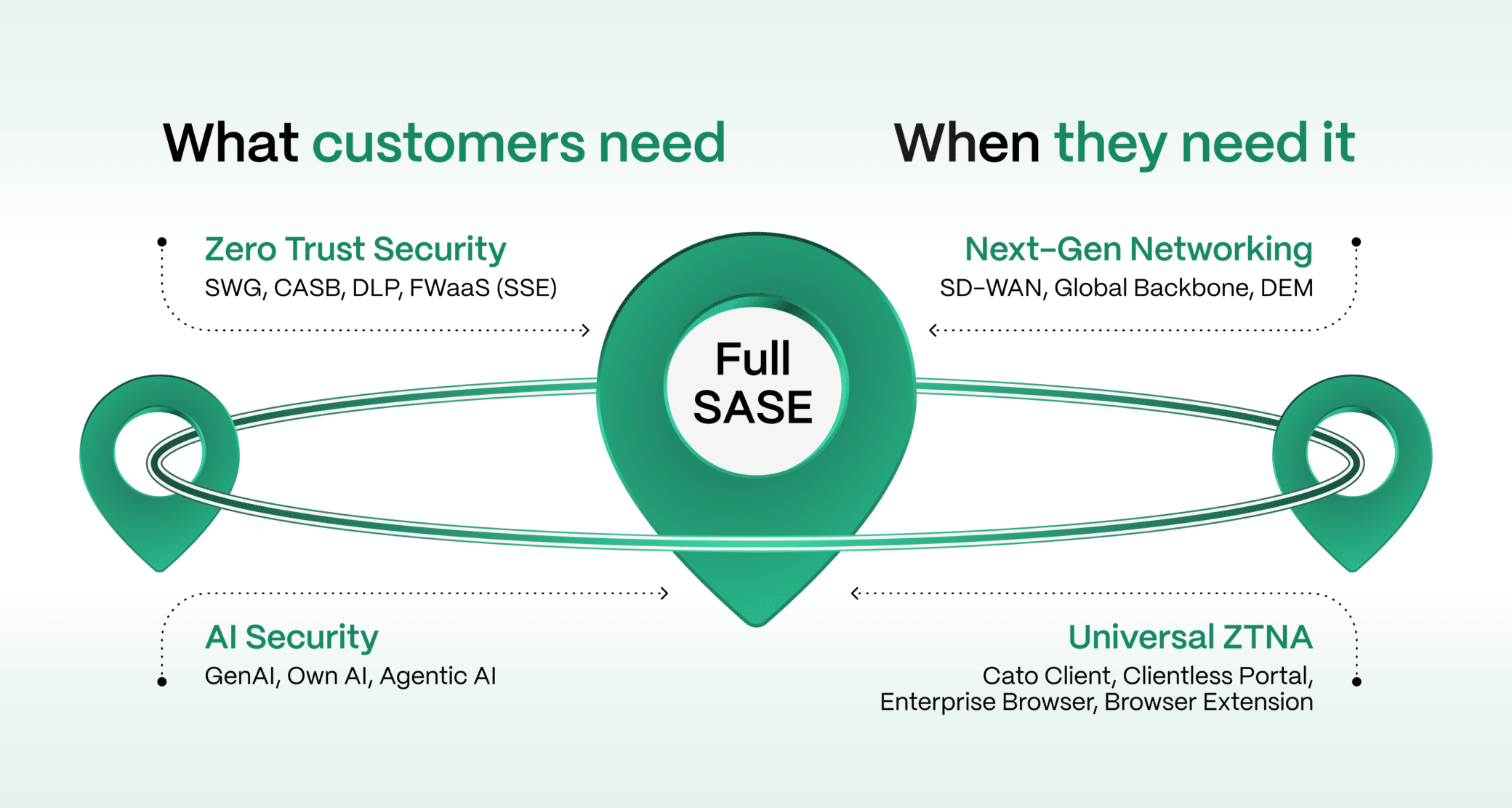
Converge networking, security, and access into a single, global, AI-powered cloud service that transforms enterprise infrastructure. Organizations experience streamlined operations, stronger threat prevention and detection, granular application and data security, and optimized user experience everywhere. Cato empowers IT to securely and optimally connect users, sites, applications, and clouds anywhere business happens
Connect Every Edge and Secure Every Connection
Converge networking and security into a single cloud-native SASE platform, with one policy engine and one console. Single-pass inspection enforces policies across the organization, while AI-driven automation reduces IT burden and enhances protection.
Consolidate point products into a single, converged platform.
Simplify operations and visibility into a single, centralized management dashboard.
Reduce time spent on maintenance and troubleshooting with automatic software and security updates.
Eliminate the time-intensive burden of hardware lifecycle management.
Gain end-to-end visibility from device to application.
Detect, diagnose, and resolve performance issues before users are impacted.
Ensure consistent, global policy enforcement for every user and application.
Empower IT with real-time insights to proactively maintain user productivity.
Accelerate growth and scale with Cato’s cloud-native platform.
Instantly connect new sites, users, and applications anywhere, anytime with zero-touch simplicity.
Embrace innovation effortlessly with a platform that simplifies technology adoption.
Maintain readiness to meet business needs at the speed of the cloud.
See SASE Platform
in Action
Shadow AI Is Everywhere. Cato Puts You Back in Control
Securely embrace the transformative power of AI across the business. Cato AI Security secures and governs all AI interactions, from safe and sanctioned third-party AI usage to runtime protection of homegrown AI applications and AI agents.
Ensure resilient, high-performance networking with zero-trust protection and AI-driven optimization. Cato next gen-networking connects every user, site, and application through a single, cloud-native platform that delivers optimized global connectivity and seamlessly coexists with existing security and access infrastructure.
Deliver comprehensive Zero Trust protection that unifies threat prevention, application and data security, UZTNA, and AI-driven incident detection and response. Cato SSE provides context-aware protection and seamless scalability across users, locations, clouds, and applications, and can be deployed independently of existing networking infrastructure.
Enable adaptive, risk-based, zero-trust access to private applications located on-premises or in the cloud. Cato offers a wide variety of access methods including ZTNA Client, Enterprise Browser, Browser Extension, and Clientless Portal that can coexist with current access solutions and be selectively deployed to secure some or all application access.
“There are not many times as a CIO that you can check the box in all these areas – faster, more secure, happy users, and a happy team – all for less cost and more business value. That’s the Cato SASE Platform.”
– Dustin Collins, CIO, Element Solutions
Try Cato
The Solution that IT teams have been waiting for.
Prepare to be amazed!
Welcome to the New Platform Economy
Secure every interaction across the enterprise, cloud, and AI with the only purpose-build SASE platform.
Securely embrace the transformative power of AI across the business. Cato AI Security secures and governs all AI interactions, from safe and sanctioned third-party AI usage to runtime protection of homegrown AI applications and AI agents.
Ensure resilient, high-performance networking with zero-trust protection and AI-driven optimization. Cato next gen-networking connects every user, site, and application through a single, cloud-native platform that delivers optimized global connectivity and seamlessly coexists with existing security and access infrastructure.
Deliver comprehensive Zero Trust protection that unifies threat prevention, application and data security, and AI-driven incident detection and response. Cato SSE provides context-aware protection and seamless scalability across users, locations, clouds, and applications, and can be deployed independently of existing networking infrastructure.
Enable adaptive, risk-based, and zero trust access to private applications, on premises and in the cloud. Cato offers a wide variety of access methods including ZTNA client, Secure Browser, and Clientless Portal that can coexist alongside current enterprise access solutions and be selectively deployed to secure a subset or all application access.
Experience streamlined operations, stronger threat prevention and detection, granular application and data security, and optimized user experience everywhere. Cato’s SASE platform converges networking, security, and access into a single, global, AI-powered cloud service that transforms enterprise infrastructure and empowers IT to securely and optimally connect users, sites, applications, and clouds anywhere business happens.
Cato NeuralEdgeembeds NVIDIA GPUs across Cato’sglobal private backbone, enabling real-time AI inspection; Cato AI Security delivers unified governance and protection for enterprise AI adoption
TEL AVIV, Israel, March 17, 2026 – Cato Networks, the SASE leader, today unveiled two major innovations for the Cato SASE Platform to secure enterprise AI adoption at scale. Cato is introducing Cato Neural Edge, deploying NVIDIA GPUs across Cato’s global private backbone to accelerate AI-driven analysis for real-time traffic inspection, threat detection, and policy enforcement. In addition, Cato is launching Cato AI Security, converging advanced AI governance and protection capabilities from its recent acquisition of Aim Security into the Cato SASE Platform. With these innovations, Cato is delivering the first SASE platform purpose-built to secure the AI era.
“AI is changing both sides of the equation: the threats we face and the defenses we need,” said Matan Getz, vice president of AI security at Cato Networks. “With Cato Neural Edge and Cato AI Security, we are empowering enterprises to strengthen AI-driven defense and govern enterprise AI without sacrificing performance or adding operational complexity.”
AI Transformation Introduces New Security Challenges
Traditional security controls were built to inspect files, user behavior, and application access, not the conversational and contextual interactions of AI prompts, chats, copilots, and agents. Without the appropriate guardrails, enterprises risk data leakage, intellectual property loss, compliance violations, and more.
At the same time, AI is redefining cybersecurity itself. Modern security increasingly relies on AI to identify anomalies, correlate signals across massive datasets, and stop attacks in real time. According to Gartner ®, “By 2028, over 75% of enterprises will be using AI-amplified cybersecurity products for most cybersecurity use cases, up from less than 25% in 2025.”1
However, delivering security for AI and AI for security at scale requires significant compute power capable of deep semantic analysis and large-scale model execution. Routing AI workloads to external GPU clouds introduces inconsistent responses and separates intelligence and enforcement, which reduces predictability and control.
To secure AI transformation, enterprises must evolve both their security controls and the infrastructure powering them.
Cato Neural Edge: NVIDIA GPU-Powered SASE at Global Scale
Cato is addressing the AI infrastructure challenge with Cato Neural Edge, a GPU-powered enforcement layer embedded within the 85+ PoPs of Cato’s global private backbone. Unlike architectures that offload AI inspection to separate hyperscaler environments, Cato executes intelligence and enforcement in the Cato PoP, providing predictable performance and architectural integrity.
Cato Neural Edge enables:
High-frequency execution of AI/ML models inline
Real-time semantic and behavioral inspection
Scalable analysis across global traffic flows
Deterministic performance without external processing layers
Cato Neural Edge provides the infrastructure foundation for smarter, faster, AI-powered network security—delivered inline, everywhere.
Cato AI Security: Unifying AI Governance and Protection
Cato is also adding its newest platform capability, Cato AI Security, unifying AI governance and runtime protection across major AI use cases—governing employee use of AI tools, securing homegrown AI applications, and enforcing guardrails for autonomous AI agents.
Cato AI Security operates as a standalone solution or alongside additional Cato SASE Platform capabilities, enabling enterprises to immediately secure AI transformation while providing a seamless path forward to broader network and security initiatives, such as SD-WAN, SSE, or Universal ZTNA (UZTNA). All capabilities are managed through a unified control plane and policy engine, sharing context to deliver faster, more precise detection and response.
“One of the biggest advantages for us is that AI security isn’t another console or separate enforcement layer. It’s built directly into the Cato SASE Platform,” said Marc Crudgington, vice president of cybersecurity and IT infrastructure at Crane Worldwide Logistics, a global logistics company. “We can govern AI usage, secure homegrown AI applications, and manage agent workflows using the same policy engine and data lake that already protect our network and cloud environments. That unified architecture reduces complexity and ensures consistent enforcement everywhere AI operates.”
Availability
Cato AI Security is generally available to customers worldwide. Cato Neural Edge has been deployed across the Cato SASE Platform.
Resources
Learn more about Cato’s acquisition of Aim Security from CEO Shlomo Kramer in this blog.
Explore Cato AI Security on our website for users here and for applications here.
Join our webinar to learn more about Cato AI Security here.
Learn about Cato Neural Edge and Cato AI Security in this blog.
Gartner Disclaimer
1Gartner, Forecast Analysis: Information Security, Worldwide, 2026, Shailendra Upadhyay, Christian Canales, Rahul Yadav, Matt Milone, Akshita Joshi, Sean ONeill, and Charanpal Bhogal, 5 February 2026
GARTNER is a trademark of Gartner, Inc. and its affiliates.
About Cato Networks
Cato Networks, a leader in SASE and AI security, delivers secure, zero-trust access everywhere to thousands of customers worldwide. Built for organizations operating across all cloud and hybrid environments, the Cato SASE Platform unifies networking, security, and access, providing them as elastic, modular capabilities that organizations can easily adopt and grow over time. Cato combines the Cato Cloud, a purpose-built global network, with simplified operational experience, all delivered across a robust, AI-driven platform. With Cato, organizations modernize confidently, operate with greater resilience, and innovate faster, without added complexity or risk.
Want to learn why thousands of organizations secure their future with Cato? Visit us at staging.catonetworks.com.
AI has moved from experimentation to a strategic enterprise imperative. It’s no longer about whether organizations will adopt AI, but whether their security architecture can govern it at the speed and scale at which it is being embedded into the business.
This is not a future concern. It is today’s operational mandate to:
Secure all AI usage
Secure homegrown AI applications
Govern autonomous AI agents
Securing AI is not limited to software applications and agents. It requires hardware infrastructure capable of sustaining its scale, performance, and AI-grade compute intensity. Cato solves for both.
Introducing Cato Neural Edge
NVIDIA GPUs are now deployed across the Cato SASE Platform, spanning 85+ PoP worldwide. The GPU-powered Cato Neural Edge provides the compute foundation to run advanced SML models at scale, enabling deeper semantic inspection, large-scale pattern analysis, and real-time adaptive intelligence inline across Cato’s global private backbone.
Traditional SASE architectures route AI workloads to separate hyperscaler GPU locations, introducing round-trip inference latency that degrades performance and limits AI traffic scalability.
Cato Neural Edge converges inspection, compute, and enforcement within the same PoP. This eliminates architectural separation and reduces latency variability. Intelligence runs where enforcement runs.
AI transformation is not only about securing AI. It is about using AI to deliver better security outcomes. GPUs in the Cato cloud enable:
Faster AI-driven threat detection
More accurate semantic data classification, and
Scalable inspection aligned with enterprise performance expectations
Cato AI Security, Native in the Cato SASE Platform
Cato is proud to offer the industry’s first SASE platform with native AI Security.
Cato’s single architecture now includes the full breadth of AI security and governance:
A single management application for One Control
A unified policy engine for One Security
A shared data lake for One Context
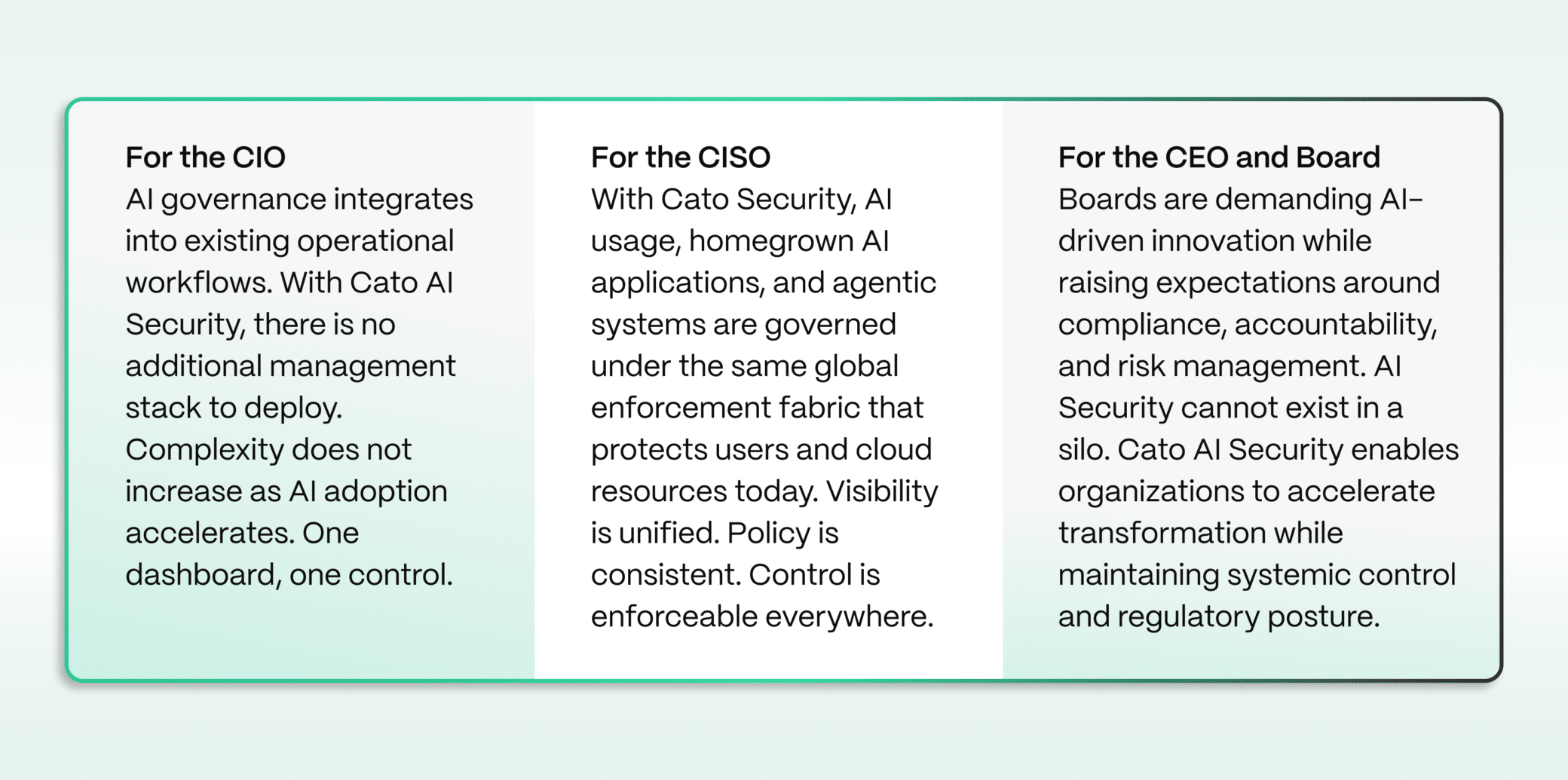
As boards mandate AI adoption and governance, AI security cannot be treated as a standalone control point. It must be embedded into the enterprise security architecture. Cato delivers unified visibility and enforcement across network, access, security, and AI governance within a single architectural framework.
Cato AI Security as a Stand-alone Solution
Importantly, Cato AI Security is available as a standalone solution. Organizations can secure their AI transformation with any combination of use cases: AI usage, homegrown AI applications, or agentic workflows.
The power of the Cato platform lies in its modularity, giving customers the flexibility to start where needed and evolve on their own terms, all with seamless, CapEx-free cloud agility.
Even as a standalone solution, Cato AI Security runs on the same global private backbone and resilient architecture that deliver enterprise-grade 99.999% SLA-backed availability. It also establishes a foundation to expand seamlessly into Zero Trust security and next-generation networking without re-architecture.
What This Means at the Executive Level
Why is the AI Security Problem Different?
AI introduces an entirely new security dimension. Traditional controls were built to inspect files, user behavior, and application access. AI risk is conversational and contextual. Enterprise security must evolve accordingly.
With AI, security teams are no longer protecting only data objects and application sessions. They are protecting intent expressed in natural language, instructions embedded in prompts, and chained actions executed by agents.
Organizations must contain Shadow AI before sensitive information is exposed. They must prevent prompt injection and jailbreak techniques that override model safeguards. They must correlate multi-stage agent actions across APIs and enterprise systems to understand cumulative impact.
To realize the full value of AI transformation, organizations must embed AI Security across the business, not bolt it on. A point-product approach creates visibility gaps and inconsistent enforcement that attackers can exploit. AI Security, that is self-standing, and yet built into a holistic enterprise network security architecture with centralized policy and full visibility delivers consistent protection across users, data, applications, and AI interactions.
From Breakthrough Research to World-Class AI Security
Effective AI security requires deep understanding of emerging AI attack techniques.
Cato AI Security is built on groundbreaking AI security research from our world-class research team (formerly Aim Labs) who uncovered EchoLeak, the first Zero-Click AI vulnerability and CurXecute, a remote-code execution vulnerability via Cursor MCP. This deep expertise of prompt injection exploitation, model manipulation, and AI-driven attack chains is translated into product innovation that delivers best-in-class AI guardrails.
Setting the Right Foundation for the AI Security Era
AI adoption and AI risk are now C-level and board-level mandates. They cannot be addressed through siloed tooling or disconnected point solutions.
Cato is the first to natively deliver AI Security as part of a converged security architecture, from a single console and policy engine to a GPU-powered global cloud platform. Enterprises can deploy AI Security as a standalone solution or alongside SSE, Universal ZTNA, or SD-WAN, while leveraging the power of a global cloud platform that maintains unified policy, consistent enforcement, and platform-wide visibility without sacrificing architectural integrity.
Backed by dedicated AI security research, Cato continuously discovers emerging AI threats and translates that intelligence directly into platform-wide protections, ensuring enterprises stay ahead of rapidly evolving risks.
The result: enterprises can accelerate AI innovation with unified visibility, proactive protection, and consistent control, without introducing new security gaps, new management consoles, or siloed point products for every emerging AI risk.
It’s time to secure your AI transformation with AI security that’s built-in, not bolted on.
Imagine two talented orchestras playing together, but without a conductor or a single score. You get noise, not music. M&A can be like that. The value lies in having every musician on the same page.
Traditional networking slows M&A execution. Cato delivers a cloud-native foundation that securely connects the new organization from day one, aligns policies and workflows under a single framework, and helps leadership realize value faster.
The gap between business velocity and IT speed is why post-merger programs can feel chaotic. With a cloud-native platform, integrations can become a repeatable process rather than a one-off fire drill.
The Hidden Costs of M&A
Inside IT, three patterns show up:
Limited Agility: New sites and users rely on hardware lead times and manual, per-site setup. Policies are rebuilt for every acquisition, Day-1 access slips and temporary workarounds extend time-to-value.
High Integration Cost: For months, organizations keep duplicate networks and overlapping security tools alive. Extra VPN concentrators, firewalls, or MPLS links are deployed to keep the business running, while OpEx climbs and the integration is half-done.
Increased Cyber Risk: During transition, parallel environments and inconsistent controls create blind spots and widen the attack surface just as IT is consumed with cutovers, tickets, and change requests.
For many teams, every acquisition feels like starting from zero.
M&A at Cloud Speed
In environments with regular acquisitions, bespoke integrations do not scale. IT teams that handle M&A convergence well share the same requirements:
Day-1 Readiness: Secure access to core applications for users, sites, plants, and partners in hours, not weeks, without waiting on hardware projects.
Unified Architecture: A single cloud-native platform that brings together networking and security for both organizations.
Centralized Visibility and Control: One place to enforce zero trust policy, inspect traffic, and see what is happening across the combined environment.
Cato’s Cloud-Native Platform Unlocks M&A Value
Cato’s SASE Platform converges Next-Gen Networking and Zero Trust Security into a single cloud-native service, leveraging a global private backbone and managed from a single console.
Rapid Onboarding
IT can preconfigure connectivity and security policies for acquired entities ahead of close. Sites connect using zero-touch Cato Sockets, existing edge devices over IPsec, or cloud-native connectors, while users connect via a lightweight client, a browser extension or a clientless portal. Instead of waiting for circuits and appliances, connectivity is implemented in hours, bringing operational transition and time-to-value closer to the deal close.
Simplified Operations
Instead of running parallel networks, VPNs, and security point products, both organizations move to a single cloud-native platform – the single orchestra score. Networking and security teams manage a single policy framework and toolset versus stitching together overlapping tools – the single conductor. This simplification reduces integration effort, cuts OpEx, and makes it easier to realize cost synergies that justified the deal.
Full-Stack Security and Visibility
Cato delivers security and visibility through a single cloud-native platform, using one policy framework and shared data. Controls are applied consistently across both environments as sites and applications move, keeping risk contained and performance predictable.
The same capabilities that fix the pains of M&A integration also deliver on the business goals behind the deal:
Faster transition off temporary setups
Earlier synergy realization
Secure, resilient operations for the combined company
Customer Spotlight: Element Solutions Inc.
Element Solutions Inc. (ESI) is a global specialty chemical company with over 100 sites and thousands of remote users, with M&A central to its growth strategy.
With ESI’s previous architecture, integrating an acquisition could take three to four months to connect new locations and expand capacity, relying on SD-WAN devices from local ISPs, site firewalls, and a remote access VPN.
After adopting the Cato to connect and secure over 100 sites and 6,000 remote users, acquired companies now join the network in weeks instead of months, cutting integration time by 80%.
The CIO reports faster integration, stronger security, happier users, and a more focused team at lower cost and higher business value.
Final Thoughts: Matching M&A Speed with the Right Architecture
M&A is demanding, but it does not have to mean slow integrations, temporary infrastructure that never goes away, and risk.
With Cato’s cloud-native, converged platform, IT teams can connect and secure organizations at the pace the business expects, while maintaining cost and risk control. One-off projects shift to a repeatable integration motion, and the time between signing the deal and seeing value gets shorter.
If your company is planning more M&A, this is the moment to review your current network and security stack and ask: when the next deal closes, will this architecture help accelerate time to value or slow everything down?
To see how this plays out, watch the Cato M&A video and explore the ESI case study for details on their journey.
Policy-based routing routes network traffic based on policy rules that might consider the source, application, user class, ports, or traffic class. This differs from traditional network routing, where the selected route is largely based on the shortest or most preferred route to the destination.
Policy-based routing can be used to achieve various goals, such as enhancing performance and reliability or implementing segmentation. These decisions may be based on application identification, allowing highly granular routing on a per-application basis.
Key Highlights
Policy-based routing steers traffic using rule criteria beyond destination-only routing.
Criteria often include source, destination, ports, protocol, DSCP, and application identity (when available).
Some platforms combine policy intent with path telemetry to support SLA-based steering (for example: latency, loss, jitter). This is related to PBR but not required for classic PBR.
PBR commonly steers application classes (for example: real-time collaboration vs bulk transfer) to preferred egress points or transports.
Poorly designed policies can create asymmetric routing, unstable failover behavior, and hard-to-troubleshoot outcomes across sites.
Successful programs treat routing policy as change-controlled logic with clear rule order, testing, observability, and rollback.
What Is Policy-Based Routing?
Policy-based routing allows an organization to control how certain types of traffic move over the network. This is accomplished by defining policies and network rules that specify where traffic should go on its next hop toward its destination.
These rules use various fields within a packet to match packets to policies. Commonly used match fields include:
Source/destination
Ports
Protocol
DSCP
Application category
Based on these fields, the traffic is mapped to a policy, which can specify the next action that the traffic should take. Common actions include:
Choosing the next hop
Choosing the interface or egress used to leave the network
Choosing the tunnel or transport protocol
Selecting a routing table or VRF
Preferring one path with an explicit fallback (when supported)
Policy-based routing focuses on where to route traffic, allowing firewalls or access control lists (ACLs) to implement allow/deny rules. Policies are often implemented as ordered rule lists – where the first match wins – to resolve conflicts when traffic matches multiple rules.
Policy-based routing is not a routing protocol like Border Gateway Protocol (BGP) or Open Shortest Path First (OSPF). It also can’t magically fix last-mile issues since it only defines how traffic should use available routes and bandwidth.
Why Do Organizations Use Policy-Based Routing?
Policy-based routing offers greater granularity and control than traditional destination-based routing. Organizations can use it to achieve various outcomes, including:
Enhanced performance for latency- sensitive apps
Improved resiliency
Deterministic segmentation
Cost control
Traditional network routing takes a “one size fits all” approach to routing, treating voice/video, SaaS, bulk backup, and admin traffic the same. By defining specific policies for these, organizations can ensure that more important and sensitive traffic is treated appropriately.
However, defining and implementing additional policies introduces additional complexity and overhead. Governance and testing are essential to ensure that policies work as designed and that the number of policies doesn’t spiral out of control.
How Does Policy-Based Routing Work?
Policy-based routing works via a multistage process. Key steps include:
Traffic identification and classification
Extraction of match fields
Finding matching policies and applying the first
Applying the specified policy action (next hop, egress, tunnel, etc.)
Applying fallback action if needed
Verifying success with logs or telemetry
Implementing policy-based routing requires selecting the conditions used to match traffic to policies, defining the actions taken in response to a match, and enforcing policies across the network.
Define match conditions
Policy-based routing uses a variety of match fields to select appropriate policies rather than simply the traffic’s destination. When implementing it, the first step is to define the match conditions that will be used to select an appropriate policy.
Policies can be matched using a variety of different fields, such as source/destination, ports, protocol, and DSCP. Modern systems increasingly rely upon application classification to apply specific policies to application traffic, even if the majority of the traffic flows over the same ports and protocol (443/HTTPS). When defining criteria, consistent identity sources (apps, devices, and users) are essential to ensure consistent enforcement across the corporate WAN.
When defining match criteria for policies, it’s wise to keep them as mutually exclusive as possible to limit the number of matches for a particular packet. When multiple policies match, conflicts are resolved via rule ordering, making careful consideration of these priorities essential to ensure that the appropriate policy is applied to traffic.
Choose an action (next hop, egress, tunnel, transport)
Policies can be defined to take various actions for matching traffic. In general, these fall into two main categories:
Deterministic Actions: Traffic may be routed to a fixed next hop, egress, or tunnel.
Policy and Measured Path Selection: Combines policy-based routing with measured path selection to support SLA-based or application-aware steering.
Often, policies are defined with a preferred path as well as a fallback in the event that something goes wrong. Policies may also include SLA thresholds regarding latency, loss, and jitter in the decision-making process as well.
When defining policies, it’s important to avoid policy loops that can break workflows. Additionally, the use of IP pinning in policies for cloud apps can introduce fragility and break policies if IP addresses change.
Enforce globally and validate outcomes
Policy-based routing should be enforced consistently across the enterprise, ensuring the same intent, predictable behavior, and measurable results in all environments. When implementing policy-based routing at scale, best practices include:
Using testing tools and simulation, where possible, to test policies before deployment
Implementing change control policies to manage the creation of new policies
Considering the effects of asymmetric routing on stateful traffic inspection and troubleshooting
Monitoring path selection rates, SLA violations, and failover events when evaluating policy success
Implementing policy-based routing as a staged process, starting small and expanding carefully
What Criteria Should Policies Use for Traffic Steering?
Policies should use a few different types of criteria when steering traffic. These include:
Identity (user and device)
Application or workload
Network data (source, destination, and ports)
Quality (latency, loss, and jitter)
DSCP (QoS markings identifying various types of traffic)
When defining criteria, it’s important to strike a balance between broad and narrow matches. Broader matches are easier to implement but may accidentally steer unintended traffic as well. Narrower matches have lower risk but increase the number of required rules.
Policies must also be prioritized to resolve conflicts when multiple policies match a packet. When defining priorities, a recommended order is:
Business-critical real-time
Interactive business apps
Bulk and backup traffic
Best effort
What Are Common Policy-Based Routing Use Cases?
Policy-based routing is intent-based steering designed to route traffic over a particular path or egress based on its needs, not its intended destination. Common use cases include:
Real-Time Apps: Sensitive to latency, loss, and jitter
Bulk or Background Traffic: Throughput-hungry but tolerant
Segmented and Controlled Egress Traffic: Egress point and route are important considerations
Policy-based routing steers traffic to a particular path but doesn’t necessarily force traffic through specific intermediate hops. Additionally, policies commonly consider link health as well, routing traffic to an alternative path if the preferred link fails an SLA threshold. However, the same use cases that make PBR valuable also create risk. Overlapping criteria, inconsistent rule order, and asymmetric routing can cause brittle outcomes if policies are not designed and tested carefully.
Real-time communications and collaboration
One common use case for policy-based routing is to enhance the performance and reliability of latency-sensitive traffic. For example, voice and video traffic should be steered to the best quality path to reduce the risk that jitter and loss will impact call quality. However, traffic shouldn’t be oversteered mid-call without guardrails due to the risk that traffic could be lost as a result.
Policy-based routing can also complement prioritization. In this case, this type of traffic would also be prioritized within the selected path.
Segmentation and controlled egress
Policy-based routing can also be used to implement segmentation and controlled access, requiring admin, regulated, or sensitive workflows to pass through specific inspection points or egress locations. For example, traffic from a particular subnet may be required to pass through an enforcement point en route to any other subnet.
When implementing segmentation and controlled egress, it’s important to note that return traffic may not necessarily follow the same path. Additionally, this use case can run the risk of introducing policy sprawl unless managed via tools like naming, tags, and templates.
Cost control and capacity management
A third application of policy-based routing is for cost and capacity management, reserving premium and more expensive paths for critical apps and cheaper links for bulk traffic. For example, backups, patching, and large file transfers should be routed over cost-effective paths since minor increases in network latency have a negligible impact on them.
These use cases are often driven by issues related to network congestion and rising latency on network paths that impact the performance of business-critical apps. The effectiveness of rerouting less critical traffic to cheaper links may become evident after comparing the performance of business-critical traffic during congestion events before and after implementing these policies.
What Can Go Wrong With Policy-Based Routing?
When implementing policy-based routing, common failure modes and pitfalls include:
Asymmetric Routing: An organization can choose which egress point or path to send outbound traffic on, but inbound traffic within the session may take a different path. This can introduce issues if security tools and enforcement points only see half of the conversation.
Policy Conflicts: When matching packets to policies, it’s possible that multiple policies will be a match. Rule ordering is used to solve these conflicts, which may mean that the correct policy isn’t the one selected.
Rule Shadowing: Rule shadowing is a type of policy conflict where a general policy is higher in the ordering than a more specific one. This means that the specific one will never be applied.
Brittle Matching: Brittle matching can be an issue if policy matches are too tightly defined. In this case, small deviations in match fields may cause the policy to no longer match and be applied.
These challenges may be solved only by analyzing a packet capture of the network traffic. This can help to determine whether the correct policies were applied in various situations. In general, a good mitigation strategy is to simplify rules, implement logging, test policies, stage changes, and validate per site.
Beyond the technical failure modes, organizations may struggle with governance. Common pitfalls include unmanaged exceptions, lack of documentation, no test plan, and no rollback.
FAQ
What is the difference between policy-based routing and dynamic routing?
Policy-based routing uses predefined policies and criteria to define how traffic should be routed. In contrast, dynamic routing is primarily based on the destination IP address and the health of various network links.
Is policy-based routing the same as application-aware routing?
Policy-based routing and application-aware routing both consider various factors when making routing decisions. However, policies are generally defined using static match fields (port, protocol, etc.), while application-aware routing considers SLA factors like latency, jitter, and packet loss when making routing decisions.
What match criteria are most reliable for cloud applications?
Application identification is the most reliable match criterion for cloud applications since cloud infrastructure is ephemeral. IP pinning is unreliable in these contexts since key IP addresses may change.
How do teams test routing policies safely?
When possible, testing should be performed in a test environment or via simulation. When rolling out to production, changes should be implemented in stages with extensive validation and testing.
What are the biggest signs that a PBR design is too complex?
Indications that a PBR design is too complex include a large number of policy exceptions, inconsistent outcomes, and frequent emergency changes. If this is the case, simplify, validate changes, and implement change management rules for policy creation.
Implementing Policy-Based Routing with Cato Networks
The Cato SASE Cloud Platform is implemented as a global network of SASE PoPs backed by a dedicated private backbone. Administrators can define network rules that specify how particular type sof traffic should be routed over the network to enhance performance or control costs. Additionally, Cato’s private backbone inherently offers greater reliability, performance, and control than the public Internet.
The Cato SASE Cloud Platform offers both security integration and granular control over network routing and performance. To learn more about the potential benefits for your business, schedule a demo.
Agentic AI does not just answer, it acts. The moment an agent has a reachable control plane, you have effectively created a “remote hands” interface into your environment. In our recent blog post, “When AI Can Act: Governing OpenClaw,” we explained why this shift breaks old security assumptions and why governance must be continuous, enforced, and context-aware rather than a one-time checklist. We also shared insights into third-party applications already being used in workflows integrated with OpenClaw, along with early adoption trends. At the same time, the industry has seen how quickly things can go sideways when OpenClaw-style gateways are exposed to the internet, often unintentionally and at scale. Public reporting has highlighted tens of thousands of internet-exposed instances, largely driven by default bindings and permissive publishing patterns, which reinforces why this needs to be governed as an ongoing security posture.
In this post, we share insights from the Cato SASE Platform on the overpermissive exposure trends we are seeing across sectors, how we make it easy for customers to quickly track and govern risky exposure to OpenClaw and other AI services through Remote Port Forwarding, and how they can enforce blocking from the Internet Firewall using the newly signed OpenClaw app.
Why AI Service Exposure Needs Continuous Enforcement
Remote access and remote control surfaces are not new. What is new is that AI services, and especially agentic frameworks like OpenClaw, can introduce a control plane that is both powerful and easy to expose by accident. In many environments, exposure happens through a combination of convenience and speed: a broad traffic source, an allow rule that “just works,” and a port range that accidentally includes a sensitive service. Over time, these patterns become invisible and normalized, until they are discovered externally.
We also see a second trend that makes governance even more urgent: OpenClaw’s ecosystem is expanding quickly, and the broader tooling and plugin landscape creates opportunities for abuse, including malicious “skills” designed to trick users or extend attacker reach.
This is exactly where posture needs to move from periodic review into continuous control. In other words, do not wait for a quarterly audit to tell you that a sensitive AI service port was left reachable from everywhere.
The problem pattern we are addressing
In customer environments we repeatedly encounter RPF rules that were never intended to be globally reachable, but effectively are. The highest-risk pattern is when an enabled rule allows a very broad and un-controlled traffic source and includes ports associated with AI service gateways. For OpenClaw, one example that has become especially relevant is TCP/18789, which has been observed in public exposure research and is often present in port ranges that were created for “temporary” access and then forgotten.
Once this kind of rule exists, it can become a quiet pathway into systems that sit behind what teams believe is a hardened perimeter. If the service behind that port is an agent gateway or something that can trigger actions, the operational risk and the blast radius change dramatically.
Where we see the most exposure, and why
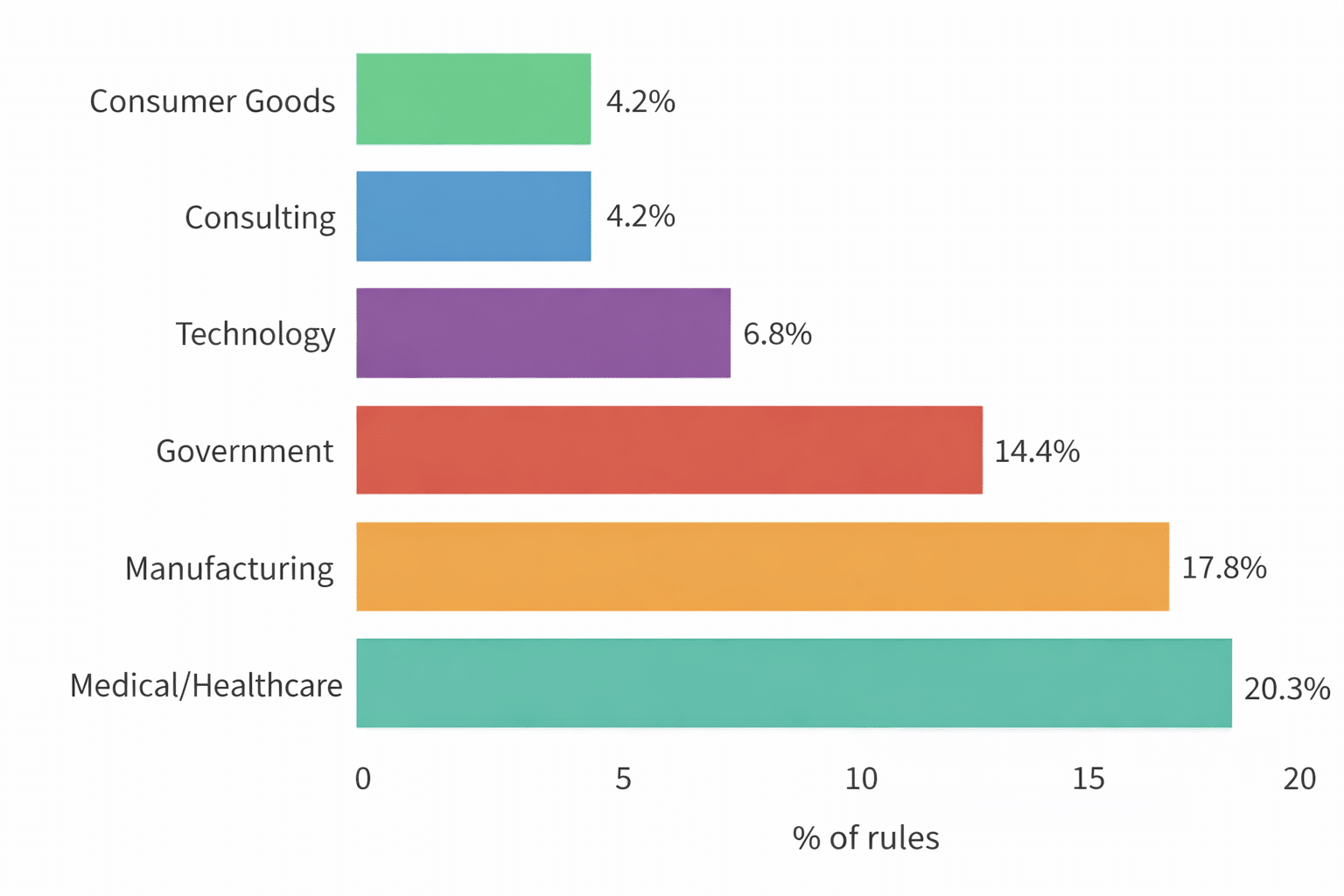
Our Cato SASE Platform telemetry shows that overly permissive AI-service exposure in Remote Port Forwarding is not evenly distributed across sectors. In Figure 1, we show the top six sectors by share of exposed rules: Medical and Healthcare (20.3%), Manufacturing (17.8%), Government (14.4%), Technology (6.8%), Consulting (4.2%), and Consumer Goods (4.2%). The concentration at the top is meaningful. These are environments where operational urgency and always-on connectivity routinely collide with security guardrails. They also tend to have a higher proportion of third-party access, distributed sites, and systems that must remain reachable for support, integration, or automation. That combination increases the likelihood that a “temporary” RPF rule is created broadly, works, and then stays in place longer than intended.
The sector drill-down adds an even sharper signal. Within Government, a large portion maps to Transportation, which commonly relies on geographically distributed infrastructure and vendor-supported systems that cannot tolerate downtime. In Healthcare, the exposure clusters around Retail-related healthcare, a space where patient-facing operations and partner integrations can drive rapid enablement and permissive access patterns. In Manufacturing, the concentration in Factories and Manufacturing and Industrial Machinery and Equipment tracks with OT and hybrid environments, where remote troubleshooting, maintenance windows, and vendor access are frequent, and port exposure can be treated as operational plumbing rather than a policy risk. In Technology, the dominance of Internet and Software and Services and Information Technology and Services suggests something else as well: earlier experimentation with agentic tooling and AI services, including OpenClaw-style gateways, alongside fast-moving build and support workflows. In short, the sectors most exposed tend to share one theme: they are both highly operational and highly connected, which makes them more likely to open access quickly, and more likely to forget to tighten it later.
Figure 1. Top sectors by percentage of overpermissive RPF rules flagged for risky AI-service exposure.
The new autonomous posture in the Cato SASE Platform
To help customers govern this risk immediately, we activated a new autonomous posture in the Cato SASE Platform under Remote Port Forwarding, titled “Overly Risky and Permissive AI-Services Exposure.” This posture continuously evaluates Remote Port Forwarding rules and highlights situations where an overly broad traffic source is combined with exposure of high-risk AI service ports in a way that can unintentionally expand the attack surface. When the platform identifies a risky combination on an enabled rule, it surfaces a clear Passed or Failed status and provides the operational context an admin needs to act, including the rule name, the exposed service indicator (for example, an exposed port such as TCP/18789 associated with OpenClaw Clawdbot or Moltbot), and an Impact: HIGH assessment. It also provides a focused recommendation: carefully review the rule and consider narrowing the internal and external port ranges as indicated by the exposed service detection, and reduce overly permissive exposure so the rule matches the minimum required access instead of the broadest possible access. Overly permissive AI-service rules can lead to unexpected outcomes or potential security risks.
Why we rate this as HIGH impact
OpenClaw is not “just another service.” It is often deployed as an agentic interface that can bridge humans, automation, and operational workflows. That makes its exposure materially different from a standard web endpoint because it can become an action surface, not only a data surface.
Our earlier OpenClaw governance post explains the core security shift: once AI can act, governance must include both visibility and enforceable controls, and those controls must be able to respond immediately as configurations drift. This posture is one concrete example of that principle applied in the RPF domain.
Internet Firewall enforcement with the OpenClaw app signature
Posture findings help you spot and fix overexposure, but many teams also want an immediate enforcement lever to stop risky access paths altogether. To support that, we added OpenClaw to the Cato App Catalog as a newly signed application, so customers can block OpenClaw directly in the Internet Firewall policy. This gives security teams a fast, centralized way to govern OpenClaw traffic at the edge, whether to prevent unsanctioned usage, enforce a phased rollout, or reduce exposure while tightening Remote Port Forwarding rules.
What you will see in the Cato SASE Platform
In Figure 2, we show the Remote Port Forwarding posture category, “Overly Risky and Permissive AI-Services Exposure,” including an example finding where the posture automatically flags OpenClaw exposure with a Failed status.
Figure 2. RPF posture finding for risky AI-service exposure.
In Figure 3, we show an example Remote Port Forwarding rule that permits a broad source and exposes a port range that includes TCP/18789, which makes the OpenClaw gateway reachable.
Figure 3. Example RPF rule exposing TCP/18789.
In Figure 4, we show the newly signed OpenClaw app added to the App Catalog, including its associated risk level and relevant category. In Figure 5, we show how to create an Internet Firewall rule to block the OpenClaw app.
Figure 4. OpenClaw app entry in the App Catalog.
Figure 5. Internet Firewall rule blocking OpenClaw.
Final Thoughts
OpenClaw is the lesson, not the exception. As agentic AI services proliferate, exposure can appear faster than traditional governance cycles can detect and correct it. That is why Cato combines two practical levers that work together. First, the autonomous posture helps you see and fix real exposure by identifying overly permissive Remote Port Forwarding rules that unintentionally publish high-risk AI service ports, and then guiding you to narrow the rule to the minimum required access. Second, the newly signed OpenClaw app in the App Catalog lets you block ahead of time by enforcing an Internet Firewall rule that prevents OpenClaw traffic from the outset, whether to stop unsanctioned usage or to control rollout. Together, visibility plus enforcement gives customers a straightforward way to govern OpenClaw and similar AI services with speed, consistency, and much less guesswork.
The ransomware kill chain is a specific version of the Cyber Kill Chain that details the various stages in a typical ransomware infection. This view can be useful for cyber defenders because it can help with identifying potential points where the threat can be detected and eliminated before data theft and encryption begin.
The various ransomware groups have different tactics, techniques, and procedures (TTPs) that they use, meaning that the ransomware kill chain isn’t “one size fits all.” However, mapping attack campaigns to frameworks like the Lockheed Martin Cyber Kill Chain or the MITRE ATT&CK framework can provide valuable insights.
Key Highlights
The ransomware kill chain breaks down an attack into stages so defenders can disrupt it before encryption occurs.
Many modern ransomware campaigns include discovery, privilege escalation, and lateral movement before the final impact.
Double extortion adds a distinct data exfiltration phase that can happen before encryption.
Network and access controls can reduce ransomware risk by blocking known malicious destinations, detecting exploits, limiting access, and preventing the transfer of sensitive data.
Breaking any stage can reduce the blast radius, response costs, and business downtime.
How the Ransomware Kill Chain Is Different from the Traditional Cyber Kill Chain
Lockheed Martin defined the Cyber Kill Chain as a general-purpose model for cyberattacks. The ransomware kill chain focuses on the specifics of ransomware attacks, often emphasizing intrusion mechanisms and the ransomware impacts of data exfiltration and encryption.
As a result, these ransomware kill chains may introduce additional malware-specific stages into the process. For example, Cisco’s ransomware kill chain includes the following stages:
Recon
Stage
Launch
Exploit
Install
Call Back
Persist
While this is a high-level model, actual ransomware attack chains vary. For example, some attackers may perform additional actions between gaining an initial foothold and pursuing impact.
Why Do Defenders Use Staged Models?
Defenders commonly use staged models because they make it easier to think about an attack and identify potential opportunities to interrupt and contain an attack. Ideally, this involves catching and eliminating the threat early within its lifecycle since this reduces the cost and complexity of remediation. Additionally, staged models make it easier to develop repeatable SOC and incident response (IR) playbooks that apply generally to multiple ransomware operators rather than a specific campaign.
The Core Stages of the Ransomware Kill Chain
Ransomware attacks can vary dramatically from one threat actor to another and even across campaigns. Additionally, different cybersecurity vendors have different models of the ransomware kill chain. However, whether the model contains four steps or nine, breaking down the process has its benefits.
In this article, we’ll use the following stages for the ransomware kill chain:
Initial Access and Infection: Malware is installed and executed on a target system
Lateral Movement and Propagation: Ransomware spreads through the network to high-value systems
Command-and-Control Communication: Malware establishes communication with the attacker for instructions and data exfiltration
Data Exfiltration: Sensitive data is exfiltrated from the network in double-extortion attacks
Encryption: Data is encrypted to induce victims to pay a ransom
How Attackers Typically Gain Initial Access in Ransomware Campaigns
Attackers can use a variety of methods to gain initial access to a target environment. Some of the most common techniques include phishing attacks, malicious websites, exploitation of exposed services, and stolen credentials.
While ransomware campaigns can vary dramatically, most attackers use one of these techniques. The reason for this is that these are often low-hanging fruit, exploiting trust, weak authentication, or unpatched systems to gain initial access.
What Initial Compromise Looks Like in Security Telemetry
After gaining an initial foothold, the attacker’s goal is to get their malware running on the infected system. Also, the malware commonly establishes a connection with command-and-control infrastructure to receive instructions and exfiltrate stolen data. This combination of actions often produces the following indicators of compromise (IoCs):
DNS lookups for suspicious or known-bad domains
Unusual outbound connections
New, unknown processes
Unexpected execution of various tools
While these can be warning signs of a ransomware infection, they’re not absolute proof. For example, a new unknown process might be a new piece of legitimate software that a user has installed and executed on their system.
What Happens after a Foothold, and Why Ransomware Operators Focus on Discovery and Lateral Movement
Ransomware operators rarely gain immediate access to their target systems. For example, a phishing attack likely compromises a user’s workstation, while ransomware is most effective on a high-value system like an important database or file server.
For this reason, attackers will often attempt to move laterally through the network, performing network scanning and exploration to identify potential targets and working to move to them. For example, an attacker might try to steal additional user credentials that would allow them to authenticate to a new system.
Common Attacker Goals in the Middle of the Ransomware Kill Chain
In the middle of the ransomware kill chain, attackers’ goals are to move from their initial entry point to high-value targets. Common actions that they might take to accomplish this include:
Credential harvesting and privilege escalation
Mapping network paths and critical assets
Disabling defenses and preparing encryption at scale
Where Data Exfiltration Fits in the Ransomware Kill Chain, and How Double Extortion Changes It
Traditional ransomware that is focused on file encryption is less effective if the victim has backups that they can restore from. For this reason, many ransomware operators have adopted double extortion techniques, stealing data before they encrypt it and threatening to leak it if the ransom is not paid. Some threat actors integrate additional extortion tactics, such as distributed denial-of-service (DDoS) attacks, as well.
Indicators and Defensive Controls That Matter Most During Exfiltration
With data exfiltration, organizations have an opportunity to identify and block an attack before it moves to the data encryption stage. This requires monitoring and policy enforcement designed to identify and block exfiltration of sensitive data and anomalous behavior, such as bulk data download and exfiltration.
How Can Security Controls Disrupt the Ransomware Kill Chain at Multiple Stages?
Mapping ransomware infections to a multi-stage model enables disruption at various stages of the process. Some ways that security controls can help to mitigate ransomware attacks include:
DNS Filtering: Identifies and blocks access attempts for malicious domains and phishing destinations.
How DNS Filtering Disrupts Early Ransomware Kill Chain Activity
DNS is used to convert domain names to IP addresses and is important at multiple stages of the ransomware kill chain. DNS lookups may be needed for the initial malware download, when establishing connections to command-and-control systems, and for data exfiltration. Blocking attempts to access suspicious and known-bad domains prevents these actions from succeeding and can terminate the attack early in the kill chain.
How IPS Helps Block Exploits and Slows Propagation
IPS is an inline security control designed to block malicious content and exploitation attempts. It can be used to prevent vulnerability exploits for initial access and the transfer of ransomware to the target environment.
How ZTNA Contains Access and Limits Lateral Movement
ZTNA implements least privilege access controls, which reduce privileges to the minimum necessary for a role and require each access request to be explicitly validated and approved. This can impair attempted lateral movement by limiting the scope of compromised accounts and allowing the organization to identify and block anomalous and suspicious requests for corporate data or resources.
How DLP Reduces Data Exfiltration Risk
DLP aims to prevent sensitive data from being shared with unauthorized recipients. In a ransomware context, this can help to prevent double extortion attacks if the DLP solution can identify and block the attempted exfiltration of stolen data.
What Security Teams Should Measure to Validate Ransomware Kill Chain Disruption
When trying to disrupt ransomware attacks earlier in the kill chain, some common metrics include:
Mean time to detection (MTTD)
Mean time to remediation (MTTR)
Reduction in the blast radius of the attack (affected endpoints, accounts, data, etc.)
Example Measurement Categories
Organizations can also implement stage-specific metrics designed to identify when they successfully identify and address a ransomware infection, including:
Prevention: Blocks at the initial access and exploit stages
Containment: Lateral movement attempts are stopped or segmented
Data Security: Exfiltration attempts detected or prevented
Impact Reduction: Lower encryption spread and faster recovery
How Does the Ransomware Kill Chain Improve Incident Response and Post-Incident Hardening?
The ransomware kill chain helps to enhance IR and post-incident hardening by offering a more concrete and granular breakdown of the attack to tie playbooks and lessons learned to. For example, a post-incident retrospective might examine whether the threat was detected at various stages (initial access, lateral movement, data exfiltration, etc.) and how the organization can implement or tune additional controls to address identified visibility or containment gaps.
Ransomware Kill Chain: How to Use the Framework to Reduce Ransomware Impact Over Time
The ransomware kill chain offers a framework for thinking about these attacks and planning security controls and IR actions. Some ways that organizations can make use of the framework include:
Build stage-based detections and controls
Run tabletop exercises aligned to stages
Review incidents by stage and tune controls
FAQ
What are the typical stages in the ransomware kill chain?
Models of the ransomware kill chain can vary in the stages included. A few common stages include initial access, lateral movement, command and control, data exfiltration, and data encryption.
Is data exfiltration always part of ransomware?
No, ransomware originally focused solely on data encryption, not exfiltration. However, double extortion attacks have become more common to prevent victims from avoiding paying the ransom by restoring from backups.
How is the ransomware kill chain related to the Cyber Kill Chain?
The Cyber Kill Chain is a general-purpose model designed to break down common stages of a wide range of potential attacks. The ransomware kill chain uses a similar breakdown but focuses on the ransomware threat.
Which controls can interrupt ransomware earlier than encryption?
Some security controls that can interrupt ransomware attacks before they reach the encryption stage include DNS filtering, in-line exploit prevention, access controls, and data controls. For example, DNS filtering can block access to webpages serving malware and command-and-control infrastructure.
What should teams prioritize if they cannot cover every stage?
If organizations can’t cover every stage of the ransomware kill chain, they should attempt to prioritize earlier stages and those where they have greater visibility and control. For example, an organization may limit user access in line with the principle of least privilege to reduce an attacker’s ability to move laterally through the network to high-value targets.
Cato Networks has been named a Leader and Outperformer in the 2026 GigaOm Radar for Secure Access Service Edge (SASE) — marking the third consecutive year we’ve earned this distinction. And, once again, Cato is positioned closest to the center of the Radar, of all participants.
In this year’s GigaOm Radar for SASE, Cato is positioned in the Maturity/Platform Play quadrant, reflecting the depth, completeness, and enterprise readiness of the Cato SASE Platform. According to GigaOm, vendors positioned as Leaders and Outperformers in this quadrant demonstrate both broad technical capabilities and the operational scale required to deliver a comprehensive, enterprise-grade SASE architecture.
For Cato, this recognition reflects sustained execution against a clear architectural vision: converging networking and security into a single, cloud-native platform built for enterprise scale, operational simplicity and measurable business outcomes.
A clear theme in this year’s Radar is that the SASE market has entered a consolidation phase. Enterprises are moving away from stitched-together, multivendor architectures and toward unified platforms. Fragmented approaches introduce integration complexity, policy inconsistencies, and visibility gaps that ultimately undermine the promise of SASE.
Cato was architected as a single, cloud-native platform that converges networking and security together, not a collection of loosely integrated products. The Cato SASE Platform delivers AI security policy enforcement, SD-WAN, a global private backbone, and a full Security Service Edge (SSE) stack through a unified architecture and single management console.
At the core is the Single Pass Cloud Engine (SPACE), which performs routing, optimization, decryption, and security inspection in a single pass to minimize latency while ensuring consistent policy enforcement.
Innovation Velocity and Outperformer Status
The GigaOm Radar for SASE evaluates vendors across key features, emerging features, and business criteria. Cato ranked highest among participating vendors in Emerging Features and Business Criteria out of 17 vendors.
Cato’s Outperformer classification reflects sustained innovation velocity, including a biweekly release cadence, the integration of Aim Security to extend protection to AI-native use cases, and continued investment in the platform. Strengths highlighted include native digital experience monitoring (DEM), AI-powered threat intelligence and analytics, predictive traffic steering across Cato’s global private backbone, and unified policy management with a single cloud-native architecture.
The Bottom Line
Three years in a row. Leader. Outperformer.
As the SASE market matures, enterprises are prioritizing unified platforms that eliminate integration gaps and operational friction and are built for scale, operational simplicity, and sustained innovation. The 2026 GigaOm Radar for SASE reinforces Cato’s architectural vision and continued leadership.