Pharmaceutical Leader Replaces MPLS with Cato Cloud, Cutting Costs While Quadrupling Capacity

Pharmaceuticals

Pharmaceutical Leader Replaces MPLS with Cato Cloud, Cutting Costs While Quadrupling Capacity

Affordable MPLS Alternative
Mobile Access Optimization
Simple Network Automation
Secure Direct Internet Access

Whatโ€™s inside?

Request a Demo
Pharmaceutical Leader Replaces MPLS with Cato Cloud, Cutting Costs While Quadrupling Capacity
The other providerโ€™s service would have meant spending around 2x more than with the Cato solution and still not get any of the security services Cato offers
Matthieu Cijsouw, Global IT Manager

Global MPLS Limits Centrient

As with many enterprises, the IT team at Centrientย Pharmaceuticals grew tired of the limitations of MPLS. Performance across the companyโ€™s 10-site, global network was for the most part โ€œsolid,โ€ says Matthieu Cijsouw Global IT Manager at Centrient. But as the applicationsโ€™ capacity requirements grew, increasingly the MPLS service was becoming congested.

โ€œUsers noticed that MPLS was slow. It took a long time for them to open documents,โ€ he says.

The high cost of MPLS bandwidth made upgrading global bandwidth unrealistic. โ€œMPLS was about 4x more than Cato for a quarter of the bandwidth,โ€ he says.

And bandwidth wasnโ€™t the only problem. Agility was also limiting Centrient. It typically took him three to four months to move a location, a bit faster in Europe. โ€œOne time, we needed to move a sales office, and the MPLS connection was simply not ready in time. It led to operational issues and difficult workarounds,โ€ he says, โ€œNeedless to say that was not appreciated by the business.โ€

Centrient Evaluates SD-WAN Alternatives

As his MPLS contract came up for renewal, Cijsouw started looking into SD-WAN. A technology partner recommended a combination of SD-WAN appliances, firewalls, and secure web gateways (SWG). But Cijsouw thought the solution would be too complex and was troubled by the dependence on the Internet middle-mile. โ€œInternet performance from many regions, particularly China mainland, fluctuates significantly during the day,โ€ he says. โ€œWe wanted a middle-mile solution.โ€

Global SD-WAN service providers, such as Cato, replace MPLS (and the Internet middle-mile) with an affordable MPLS alternative. The Cato Cloud Network is a global, geographically distributed, SLA-backed network of PoPs, interconnected by multiple tier-1 IP backbones. Cato dynamically selects the optimum IP backbone for every packet giving Cato Cloud better performance and uptime than any one of the underlying networks.

But while Cato Cloud provides global connectivity at Internet-like prices thatโ€™s not the case for every global SD-WAN service provider.

โ€œThe other providerโ€™s service would have meant spending around 2x more than with the Cato solution and still not get any of the security services Cato offers.โ€

After meeting with the Cato team, he decided to run a proof of concept (PoC). Cato Sockets, Catoโ€™s zero-touch, SD-WAN appliances, were installed in three locations alongside the existing MPLS circuits. Firewall rules steered traffic from specific hosts onto the Cato Cloud. โ€œWe did load balancing, failover tests, and load tests and Cato passed them all,โ€ he says.

During the next phase, he put a production load on Cato Cloud to see if there would be any hiccups. Not only werenโ€™t there any problems, but users noticed that applications were even more responsive, he says.

Like many enterprises, there was initially some concern about moving the global backbone to a startup. โ€œFor a pharmaceutical company, itโ€™s not very normal,โ€ says Cijsouw. He convinced management of the Cato Cloudโ€™s value and showed how he could minimize risk.

โ€œWe migrated to Cato in stages, gaining confidence along the way,โ€ he says, โ€œEven with a full deployment, I can bring up a global, site-to-site VPN in two hours should something happen, but I donโ€™t see that as a concern. Not only does Cato Cloud perform well, but the support Cato offers is insanely great. I never experienced such a fast response.โ€

Centrient Switches from MPLS to Cato Cloud

In the end, he decided to move all MPLS locations to Cato Cloud. โ€œIt only took us about a month,โ€ Cijsouw says, โ€œThe actual cutover was done in 30 minutes.โ€

Most locations had been equipped with 6 Mbits/s MPLS connections. He replaced those with two, and in some cases, three local Internet connections for an aggregate capacity of 20 Mbits/s per site, burstable to 40 Mbits/s. Datacenter capacity is even higher, up to 50 Mbits/s, burstable to 100 Mbits/s โ€” enough for current usage.

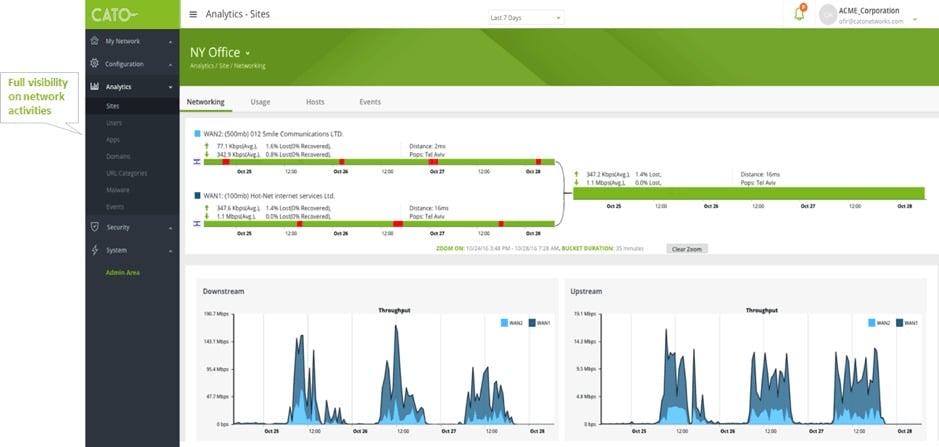
With Cato Cloud, Centrient gained deep visibility into network performance.

The additional connections were dual-homed for maximum availability. To ensure complete redundancy in the physical layers (including wiring and ducting), Cijsouw followed best practices and connected sites to the Internet with separate technologies โ€” typically glass fiber and radio connections.

Not only has he reduced his costs, but with more capacity, his applications continue to perform as well, if not better, than with MPLS.

โ€œThe voice quality of Skype for Business over Cato Cloud has been the same as with MPLS but, of course, at a fraction of the costโ€, he says. โ€œIn fact, if we measure it, the packet loss and latency figures appear to be even better.โ€

His connections into China also work equally or โ€œeven betterโ€ than with MPLS, he says.

And with Cato Cloud, he gained greater visibility into his network. The reporting is very โ€œaccessibleโ€ with detailed statistics online usage, he says.

A More Agile Future With Cato Cloud

As Cijsouw looks ahead, Cato Cloud will afford him flexibility โ€” and negotiating strength โ€” in other areas of his network. His firewall appliances, for example, are coming up for renewal in a year. Besides providing site security, they also serve as his mobile access solution. ย With Cato Security Services and Catoโ€™s mobile client bundled with Cato Cloud, he could replace both and save on licensing and operational costs. โ€œToday, we outsource firewall maintenance for about 25 percent of our networking budget,โ€ he says, โ€œWith Cato that wouldnโ€™t be necessary.โ€

Overall, how would he summarize his Cato experience? โ€œItโ€™s been really excellent,โ€ he says.

โ€œProduct delivery, support have all been there. With Cato Cloud, not only did I receive a more agile infrastructure, but I also received an agile partner who can keep up with my needs. ย We operate faster because of Cato.โ€

About Centrient Pharmaceuticals

Centrient Pharmaceuticals is a global pharmaceutical company and a leader in sustainable antibiotics, next-generation statins, and antifungals. Before Cato, Centrient had a global MPLS service connecting its Netherlands datacenter with nine manufacturing and office locations across China, India, the Netherlands, Spain, and Mexico. Local Internet breakouts secured by onsite firewall appliances provided access to the public Internet, Office 365, and other SaaS applications. Internal applications, SAP, VoIP, and Azure traffic were sent across MPLS to Centrientโ€™s datacenter, which had an ExpressRoute connection to Azure. Five small locations across the USA, Moscow, Cairo, Mumbai VPNed across the Internet to India or the Netherlands office.

More customer stories

Baltimore Aircoil Replaces MPLS with Cato, Improving Voice Quality, Enabling Video Conferencing, and Increasing Agility

Manufacturing

Baltimore Aircoil Replaces MPLS with Cato, Improving Voice Quality, Enabling Video Conferencing, and Increasing Agility
Baltimore Aircoil Replaces MPLS with Cato, Improving Voice Quality, Enabling Video Conferencing, and Increasing Agility Global MPLS Limits Centrient As with many enterprises, the IT team at Centrientย Pharmaceuticals grew tired of the limitations of MPLS. Performance across the companyโ€™s 10-site, global network was for the most part โ€œsolid,โ€ says Matthieu Cijsouw Global IT Manager at Centrient. But as the applicationsโ€™ capacity requirements grew, increasingly the MPLS service was becoming congested. โ€œUsers noticed that MPLS was slow. It took a long time for them to open documents,โ€ he says. The high cost of MPLS bandwidth made upgrading global bandwidth unrealistic. โ€œMPLS was about 4x more than Cato for a quarter of the bandwidth,โ€ he says. And bandwidth wasnโ€™t the only problem. Agility was also limiting Centrient. It typically took him three to four months to move a location, a bit faster in Europe. โ€œOne time, we needed to move a sales office, and the MPLS connection was simply not ready in time. It led to operational issues and difficult workarounds,โ€ he says, โ€œNeedless to say that was not appreciated by the business.โ€ Centrient Evaluates SD-WAN Alternatives As his MPLS contract came up for renewal, Cijsouw started looking into SD-WAN. A technology partner recommended a combination of SD-WAN appliances, firewalls, and secure web gateways (SWG). But Cijsouw thought the solution would be too complex and was troubled by the dependence on the Internet middle-mile. โ€œInternet performance from many regions, particularly China mainland, fluctuates significantly during the day,โ€ he says. โ€œWe wanted a middle-mile solution.โ€ Global SD-WAN service providers, such as Cato, replace MPLS (and the Internet middle-mile) with an affordable MPLS alternative. The Cato Cloud Network is a global, geographically distributed, SLA-backed network of PoPs, interconnected by multiple tier-1 IP backbones. Cato dynamically selects the optimum IP backbone for every packet giving Cato Cloud better performance and uptime than any one of the underlying networks. But while Cato Cloud provides global connectivity at Internet-like prices thatโ€™s not the case for every global SD-WAN service provider. โ€œThe other providerโ€™s service would have meant spending around 2x more than with the Cato solution and still not get any of the security services Cato offers.โ€ After meeting with the Cato team, he decided to run a proof of concept (PoC). Cato Sockets, Catoโ€™s zero-touch, SD-WAN appliances, were installed in three locations alongside the existing MPLS circuits. Firewall rules steered traffic from specific hosts onto the Cato Cloud. โ€œWe did load balancing, failover tests, and load tests and Cato passed them all,โ€ he says. During the next phase, he put a production load on Cato Cloud to see if there would be any hiccups. Not only werenโ€™t there any problems, but users noticed that applications were even more responsive, he says. Like many enterprises, there was initially some concern about moving the global backbone to a startup. โ€œFor a pharmaceutical company, itโ€™s not very normal,โ€ says Cijsouw. He convinced management of the Cato Cloudโ€™s value and showed how he could minimize risk. โ€œWe migrated to Cato in stages, gaining confidence along the way,โ€ he says, โ€œEven with a full deployment, I can bring up a global, site-to-site VPN in two hours should something happen, but I donโ€™t see that as a concern. Not only does Cato Cloud perform well, but the support Cato offers is insanely great. I never experienced such a fast response.โ€ Centrient Switches from MPLS to Cato Cloud In the end, he decided to move all MPLS locations to Cato Cloud. โ€œIt only took us about a month,โ€ Cijsouw says, โ€œThe actual cutover was done in 30 minutes.โ€ Most locations had been equipped with 6 Mbits/s MPLS connections. He replaced those with two, and in some cases, three local Internet connections for an aggregate capacity of 20 Mbits/s per site, burstable to 40 Mbits/s. Datacenter capacity is even higher, up to 50 Mbits/s, burstable to 100 Mbits/s โ€” enough for current usage. With Cato Cloud, Centrient gained deep visibility into network performance. The additional connections were dual-homed for maximum availability. To ensure complete redundancy in the physical layers (including wiring and ducting), Cijsouw followed best practices and connected sites to the Internet with separate technologies โ€” typically glass fiber and radio connections. Not only has he reduced his costs, but with more capacity, his applications continue to perform as well, if not better, than with MPLS. โ€œThe voice quality of Skype for Business over Cato Cloud has been the same as with MPLS but, of course, at a fraction of the costโ€, he says. โ€œIn fact, if we measure it, the packet loss and latency figures appear to be even better.โ€ His connections into China also work equally or โ€œeven betterโ€ than with MPLS, he says. And with Cato Cloud, he gained greater visibility into his network. The reporting is very โ€œaccessibleโ€ with detailed statistics online usage, he says. A More Agile Future With Cato Cloud As Cijsouw looks ahead, Cato Cloud will afford him flexibility โ€” and negotiating strength โ€” in other areas of his network. His firewall appliances, for example, are coming up for renewal in a year. Besides providing site security, they also serve as his mobile access solution. ย With Cato Security Services and Catoโ€™s mobile client bundled with Cato Cloud, he could replace both and save on licensing and operational costs. โ€œToday, we outsource firewall maintenance for about 25 percent of our networking budget,โ€ he says, โ€œWith Cato that wouldnโ€™t be necessary.โ€ Overall, how would he summarize his Cato experience? โ€œItโ€™s been really excellent,โ€ he says. โ€œProduct delivery, support have all been there. With Cato Cloud, not only did I receive a more agile infrastructure, but I also received an agile partner who can keep up with my needs. ย We operate faster because of Cato.โ€
Read customer story Search
CIAL Dun & Bradstreet Improves Networking and Security in Latin American with Cato

Financial Services

CIAL Dun & Bradstreet Improves Networking and Security in Latin American with Cato
CIAL Dun & Bradstreet Improves Networking and Security in Latin American with Cato Global MPLS Limits Centrient As with many enterprises, the IT team at Centrientย Pharmaceuticals grew tired of the limitations of MPLS. Performance across the companyโ€™s 10-site, global network was for the most part โ€œsolid,โ€ says Matthieu Cijsouw Global IT Manager at Centrient. But as the applicationsโ€™ capacity requirements grew, increasingly the MPLS service was becoming congested. โ€œUsers noticed that MPLS was slow. It took a long time for them to open documents,โ€ he says. The high cost of MPLS bandwidth made upgrading global bandwidth unrealistic. โ€œMPLS was about 4x more than Cato for a quarter of the bandwidth,โ€ he says. And bandwidth wasnโ€™t the only problem. Agility was also limiting Centrient. It typically took him three to four months to move a location, a bit faster in Europe. โ€œOne time, we needed to move a sales office, and the MPLS connection was simply not ready in time. It led to operational issues and difficult workarounds,โ€ he says, โ€œNeedless to say that was not appreciated by the business.โ€ Centrient Evaluates SD-WAN Alternatives As his MPLS contract came up for renewal, Cijsouw started looking into SD-WAN. A technology partner recommended a combination of SD-WAN appliances, firewalls, and secure web gateways (SWG). But Cijsouw thought the solution would be too complex and was troubled by the dependence on the Internet middle-mile. โ€œInternet performance from many regions, particularly China mainland, fluctuates significantly during the day,โ€ he says. โ€œWe wanted a middle-mile solution.โ€ Global SD-WAN service providers, such as Cato, replace MPLS (and the Internet middle-mile) with an affordable MPLS alternative. The Cato Cloud Network is a global, geographically distributed, SLA-backed network of PoPs, interconnected by multiple tier-1 IP backbones. Cato dynamically selects the optimum IP backbone for every packet giving Cato Cloud better performance and uptime than any one of the underlying networks. But while Cato Cloud provides global connectivity at Internet-like prices thatโ€™s not the case for every global SD-WAN service provider. โ€œThe other providerโ€™s service would have meant spending around 2x more than with the Cato solution and still not get any of the security services Cato offers.โ€ After meeting with the Cato team, he decided to run a proof of concept (PoC). Cato Sockets, Catoโ€™s zero-touch, SD-WAN appliances, were installed in three locations alongside the existing MPLS circuits. Firewall rules steered traffic from specific hosts onto the Cato Cloud. โ€œWe did load balancing, failover tests, and load tests and Cato passed them all,โ€ he says. During the next phase, he put a production load on Cato Cloud to see if there would be any hiccups. Not only werenโ€™t there any problems, but users noticed that applications were even more responsive, he says. Like many enterprises, there was initially some concern about moving the global backbone to a startup. โ€œFor a pharmaceutical company, itโ€™s not very normal,โ€ says Cijsouw. He convinced management of the Cato Cloudโ€™s value and showed how he could minimize risk. โ€œWe migrated to Cato in stages, gaining confidence along the way,โ€ he says, โ€œEven with a full deployment, I can bring up a global, site-to-site VPN in two hours should something happen, but I donโ€™t see that as a concern. Not only does Cato Cloud perform well, but the support Cato offers is insanely great. I never experienced such a fast response.โ€ Centrient Switches from MPLS to Cato Cloud In the end, he decided to move all MPLS locations to Cato Cloud. โ€œIt only took us about a month,โ€ Cijsouw says, โ€œThe actual cutover was done in 30 minutes.โ€ Most locations had been equipped with 6 Mbits/s MPLS connections. He replaced those with two, and in some cases, three local Internet connections for an aggregate capacity of 20 Mbits/s per site, burstable to 40 Mbits/s. Datacenter capacity is even higher, up to 50 Mbits/s, burstable to 100 Mbits/s โ€” enough for current usage. With Cato Cloud, Centrient gained deep visibility into network performance. The additional connections were dual-homed for maximum availability. To ensure complete redundancy in the physical layers (including wiring and ducting), Cijsouw followed best practices and connected sites to the Internet with separate technologies โ€” typically glass fiber and radio connections. Not only has he reduced his costs, but with more capacity, his applications continue to perform as well, if not better, than with MPLS. โ€œThe voice quality of Skype for Business over Cato Cloud has been the same as with MPLS but, of course, at a fraction of the costโ€, he says. โ€œIn fact, if we measure it, the packet loss and latency figures appear to be even better.โ€ His connections into China also work equally or โ€œeven betterโ€ than with MPLS, he says. And with Cato Cloud, he gained greater visibility into his network. The reporting is very โ€œaccessibleโ€ with detailed statistics online usage, he says. A More Agile Future With Cato Cloud As Cijsouw looks ahead, Cato Cloud will afford him flexibility โ€” and negotiating strength โ€” in other areas of his network. His firewall appliances, for example, are coming up for renewal in a year. Besides providing site security, they also serve as his mobile access solution. ย With Cato Security Services and Catoโ€™s mobile client bundled with Cato Cloud, he could replace both and save on licensing and operational costs. โ€œToday, we outsource firewall maintenance for about 25 percent of our networking budget,โ€ he says, โ€œWith Cato that wouldnโ€™t be necessary.โ€ Overall, how would he summarize his Cato experience? โ€œItโ€™s been really excellent,โ€ he says. โ€œProduct delivery, support have all been there. With Cato Cloud, not only did I receive a more agile infrastructure, but I also received an agile partner who can keep up with my needs. ย We operate faster because of Cato.โ€
Read customer story Search
Diamond Braces Uses Cato to Boost WAN Security, Performance, and Reliability

Healthcare

Diamond Braces Uses Cato to Boost WAN Security, Performance, and Reliability
Diamond Braces Uses Cato to Boost WAN Security, Performance, and Reliability Global MPLS Limits Centrient As with many enterprises, the IT team at Centrientย Pharmaceuticals grew tired of the limitations of MPLS. Performance across the companyโ€™s 10-site, global network was for the most part โ€œsolid,โ€ says Matthieu Cijsouw Global IT Manager at Centrient. But as the applicationsโ€™ capacity requirements grew, increasingly the MPLS service was becoming congested. โ€œUsers noticed that MPLS was slow. It took a long time for them to open documents,โ€ he says. The high cost of MPLS bandwidth made upgrading global bandwidth unrealistic. โ€œMPLS was about 4x more than Cato for a quarter of the bandwidth,โ€ he says. And bandwidth wasnโ€™t the only problem. Agility was also limiting Centrient. It typically took him three to four months to move a location, a bit faster in Europe. โ€œOne time, we needed to move a sales office, and the MPLS connection was simply not ready in time. It led to operational issues and difficult workarounds,โ€ he says, โ€œNeedless to say that was not appreciated by the business.โ€ Centrient Evaluates SD-WAN Alternatives As his MPLS contract came up for renewal, Cijsouw started looking into SD-WAN. A technology partner recommended a combination of SD-WAN appliances, firewalls, and secure web gateways (SWG). But Cijsouw thought the solution would be too complex and was troubled by the dependence on the Internet middle-mile. โ€œInternet performance from many regions, particularly China mainland, fluctuates significantly during the day,โ€ he says. โ€œWe wanted a middle-mile solution.โ€ Global SD-WAN service providers, such as Cato, replace MPLS (and the Internet middle-mile) with an affordable MPLS alternative. The Cato Cloud Network is a global, geographically distributed, SLA-backed network of PoPs, interconnected by multiple tier-1 IP backbones. Cato dynamically selects the optimum IP backbone for every packet giving Cato Cloud better performance and uptime than any one of the underlying networks. But while Cato Cloud provides global connectivity at Internet-like prices thatโ€™s not the case for every global SD-WAN service provider. โ€œThe other providerโ€™s service would have meant spending around 2x more than with the Cato solution and still not get any of the security services Cato offers.โ€ After meeting with the Cato team, he decided to run a proof of concept (PoC). Cato Sockets, Catoโ€™s zero-touch, SD-WAN appliances, were installed in three locations alongside the existing MPLS circuits. Firewall rules steered traffic from specific hosts onto the Cato Cloud. โ€œWe did load balancing, failover tests, and load tests and Cato passed them all,โ€ he says. During the next phase, he put a production load on Cato Cloud to see if there would be any hiccups. Not only werenโ€™t there any problems, but users noticed that applications were even more responsive, he says. Like many enterprises, there was initially some concern about moving the global backbone to a startup. โ€œFor a pharmaceutical company, itโ€™s not very normal,โ€ says Cijsouw. He convinced management of the Cato Cloudโ€™s value and showed how he could minimize risk. โ€œWe migrated to Cato in stages, gaining confidence along the way,โ€ he says, โ€œEven with a full deployment, I can bring up a global, site-to-site VPN in two hours should something happen, but I donโ€™t see that as a concern. Not only does Cato Cloud perform well, but the support Cato offers is insanely great. I never experienced such a fast response.โ€ Centrient Switches from MPLS to Cato Cloud In the end, he decided to move all MPLS locations to Cato Cloud. โ€œIt only took us about a month,โ€ Cijsouw says, โ€œThe actual cutover was done in 30 minutes.โ€ Most locations had been equipped with 6 Mbits/s MPLS connections. He replaced those with two, and in some cases, three local Internet connections for an aggregate capacity of 20 Mbits/s per site, burstable to 40 Mbits/s. Datacenter capacity is even higher, up to 50 Mbits/s, burstable to 100 Mbits/s โ€” enough for current usage. With Cato Cloud, Centrient gained deep visibility into network performance. The additional connections were dual-homed for maximum availability. To ensure complete redundancy in the physical layers (including wiring and ducting), Cijsouw followed best practices and connected sites to the Internet with separate technologies โ€” typically glass fiber and radio connections. Not only has he reduced his costs, but with more capacity, his applications continue to perform as well, if not better, than with MPLS. โ€œThe voice quality of Skype for Business over Cato Cloud has been the same as with MPLS but, of course, at a fraction of the costโ€, he says. โ€œIn fact, if we measure it, the packet loss and latency figures appear to be even better.โ€ His connections into China also work equally or โ€œeven betterโ€ than with MPLS, he says. And with Cato Cloud, he gained greater visibility into his network. The reporting is very โ€œaccessibleโ€ with detailed statistics online usage, he says. A More Agile Future With Cato Cloud As Cijsouw looks ahead, Cato Cloud will afford him flexibility โ€” and negotiating strength โ€” in other areas of his network. His firewall appliances, for example, are coming up for renewal in a year. Besides providing site security, they also serve as his mobile access solution. ย With Cato Security Services and Catoโ€™s mobile client bundled with Cato Cloud, he could replace both and save on licensing and operational costs. โ€œToday, we outsource firewall maintenance for about 25 percent of our networking budget,โ€ he says, โ€œWith Cato that wouldnโ€™t be necessary.โ€ Overall, how would he summarize his Cato experience? โ€œItโ€™s been really excellent,โ€ he says. โ€œProduct delivery, support have all been there. With Cato Cloud, not only did I receive a more agile infrastructure, but I also received an agile partner who can keep up with my needs. ย We operate faster because of Cato.โ€
Read customer story Search